

Watching a live feed from your phone is useful, but a camera that works with your smart home system turns that feed into action. It can trigger lights when it sees motion on your driveway, announce a package delivery over your speakers, or turn on the air conditioning when it recognizes you pulling into the garage.
Home Assistant security cameras close the gap between seeing what happens and having your home respond to it. We looked at the Best Home Assistant Security Cameras to find models that offer reliable local control, protect your data, and integrate without monthly fees.
Our overall pick for best Home Assistant security cameras is the Tapo 2K Pan/Tilt Security Camera. It delivers smooth pan-and-tilt control, clear two-way audio, and straightforward integration with common voice assistants, making it a practical hub for watching over indoor spaces. Our top picks are just below.
Our Top Picks
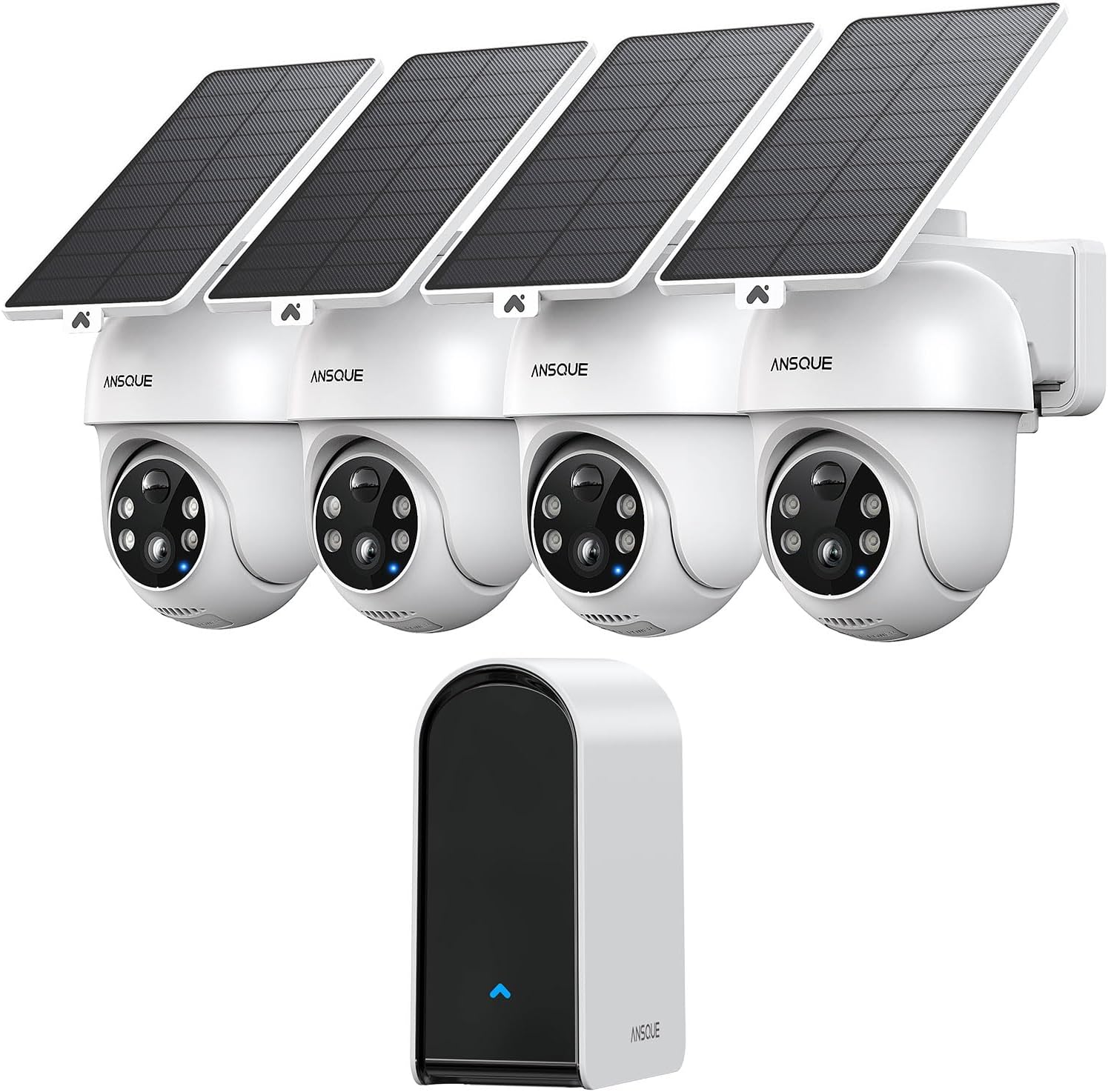
ANSQUE GU01 4-Cam Solar Wireless Outdoor Security Kit: No Fees, 360° Coverage for Porches, Driveways
Pros
- Local storage keeps footage secure at home base even if cameras are stolen
- Solar panels provide reliable power with minimal recharging needs
- Color night vision reveals details like faces or license plates up to 40 feet
- App shows multiple camera feeds at once for whole-property oversight
- Event tracking links clips across cameras for complete incident views
Cons
- Records only on motion events, not continuous 24/7 video
- Solar charging works best in sunny spots; shaded areas may need backup power
- Multi-camera setup requires strong WiFi coverage across the property
This four-camera kit positions security where it counts most, like overlooking the front porch for deliveries and the backyard gate for family safety. Each camera pans a full 360 degrees and tilts to follow people moving around your property, eliminating blind spots that leave driveways or side paths unchecked. Color night vision picks up clear details even after dark, helping you identify visitors or spot trouble early without squinting at grainy footage.
A central base station handles 32GB local storage for event clips up to 120 days, keeping your videos private and accessible even during internet outages. When motion triggers a camera, it wakes quickly, tracks the person across views if needed, and sends alerts to your phone. Set custom zones in the app to ignore street traffic, so you focus on real threats near your home, like someone lingering by the garage.
Switch modes for home, away, or sleep times to ramp up recording during vacations, ensuring the system watches over empty houses. Two-way talk lets you warn off strangers from your phone, adding a layer of deterrence for porches or pools. Solar panels keep batteries charged through typical weather, making it a low-maintenance choice for ongoing property protection without monthly bills.
Installation involves mounting cameras high on eaves or poles for broad coverage, connecting wirelessly to the base for stable feeds. This setup gives everyday homeowners reliable eyes on key areas, reducing worry about unseen activity around the yard or entrances.
Mount cameras high on porches, garages, or fences for optimal coverage of driveways, backyards, and entry points. Aim for spots with partial sun exposure to keep solar panels efficient while avoiding direct downspouts or heavy tree cover.
- Front porch: Face toward the street to catch approaching visitors or packages.
- Driveway: Position to sweep the full length, tracking cars or walkers.
- Backyard gate: Angle for pool or play area oversight, following movement.
- Side paths: Use pan-tilt to cover corners where intruders might hide.
Test views in the app before finalizing to ensure no blind spots remain around the property.
Solar panels deliver up to 365 days of battery life with just a few hours of daily sun, cutting recharges to near zero in most yards. The base station's 32GB storage holds 120 days of event clips, looping older ones as needed.
- Works offline: Records motion to base during outages, viewable later.
- No subscriptions: All app features free, data encrypted locally.
- Low-light backup: Charge indoors if shaded; panels handle clouds or rain.
- Event-only recording: Saves battery by activating on PIR motion up to 40 feet.

Pros
- Pan and tilt covers entire rooms, reducing blind spots for better monitoring of play areas or pet zones
- Motion and person detection cuts down on unnecessary alerts from everyday home activity
- Clear night vision up to 30 feet lets you see details in dark bedrooms or hallways
- Two-way audio works well for quick check-ins with kids or calming pets remotely
- Device sharing allows both parents to view feeds without extra setup
Cons
- Power cord requires an outlet nearby, limiting placement in larger rooms without extension
- MicroSD card for local storage sold separately, adding to initial setup cost
- Indoor use only, so it won't cover garages or patios exposed to weather
This two-pack of Tapo C210 cameras provides straightforward indoor monitoring for everyday home needs. Place one in the nursery to watch over sleeping kids with cry detection that sends phone alerts, so you know right away if they stir. The pan and tilt movement follows activity across the room, keeping pets or toddlers in view without you needing to adjust manually.
In living areas or near entry doors, the motion tracking catches movement like a package being dropped off inside or someone entering, notifying you instantly to check your phone feed. Night vision ensures you see clear details up to 30 feet away, even in pitch-black hallways, giving peace of mind after dark. Two-way audio lets you speak to family members or use the siren to deter anyone suspicious.
Setup connects quickly to your phone app, and you can share access with a spouse for joint viewing of kids in playrooms or pets in kitchens. Local storage on a microSD card keeps recordings without fees, though cloud options add scheduled checks or clip saves. Overall, these cameras fit well for renters or homeowners wanting reliable room coverage without complexity.
For multi-room setups, view up to four feeds at once, making it practical to oversee the whole house from one screen. The focus stays on real alerts that matter, like distinguishing pet play from actual entry, reducing phone buzz from minor motions.
Position these cameras high on walls or shelves in key indoor spots for best coverage. Aim for corners to maximize the 360-degree pan and tilt range over rooms like nurseries or living areas.
- Nursery: Mount 6-8 feet up, facing crib for cry detection and night views.
- Living room: Corner shelf overlooking play space and entry door.
- Kitchen/hallway: Near outlets to watch pets or deliveries without cord stretch.
- Avoid direct light sources to prevent glare on night vision.
Keep within 30 feet of activity for sharp tracking, and test pan/tilt via app before final spot.
Record footage locally or via cloud to review home activity like kid play or pet movements. No subscription needed for basics, but extras enhance usability.
- Local storage: Up to 512GB microSD card (not included) for continuous recording; check TP-Link site for compatible cards.
- Cloud with Tapo Care: 30-day history, auto-clip saves on motion, and sharing for family review.
- App playback: Search by date, schedule recordings, or save preset angles for quick checks.
- Supports up to 32 cameras for multi-room setups.
Schedule recordings for peak times, like after-school hours, to capture relevant events without full-time storage use.
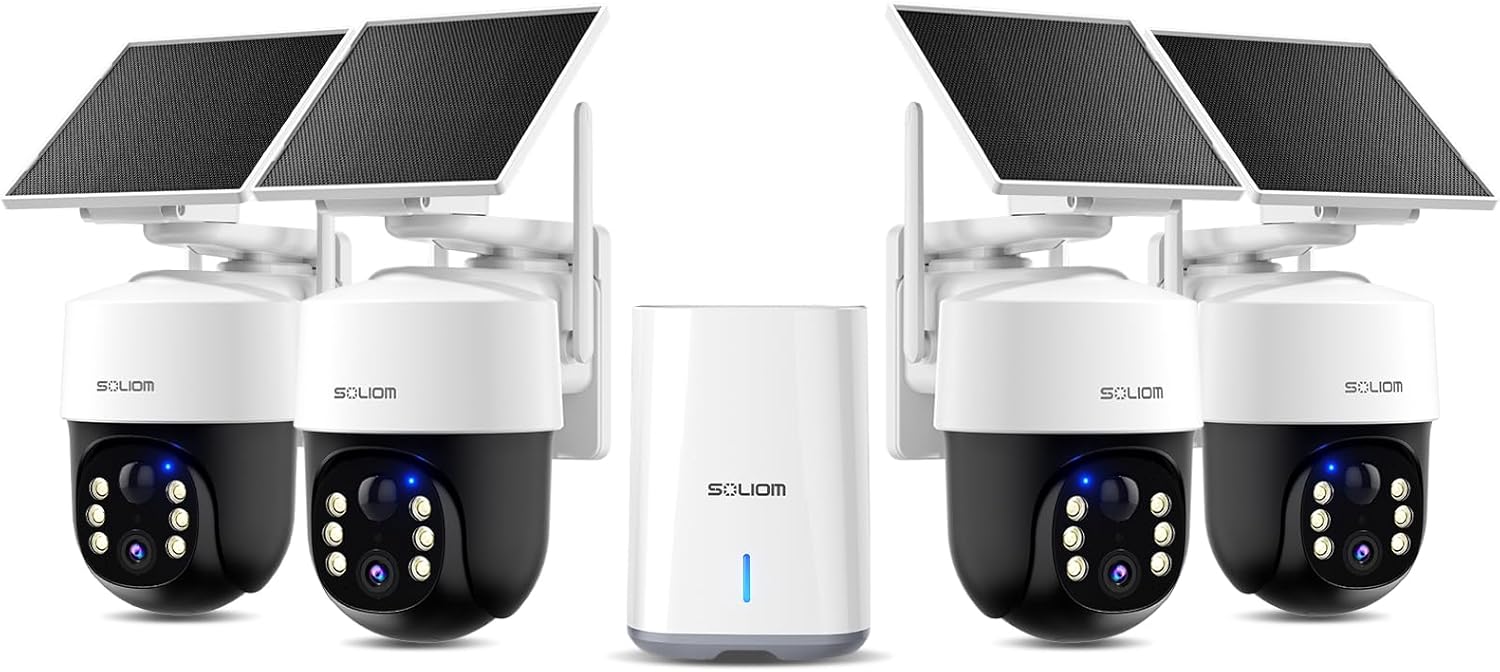
Soliom SH801 4K Solar Wireless Outdoor Cameras: Clear Yard Monitoring Without Subscriptions
Pros
- Sharp 4K video identifies details like faces or plates from driveway distances
- Radar detection cuts false alerts from trees or heat, focusing on real people
- Solar panels keep cameras running daily with just a few hours of sun
- Multi-camera linking shows events in order as someone moves around your property
- Local storage on the base means no cloud fees and secure access anytime
Cons
- Solar charging slows in extended cloudy weather or shaded spots, needing occasional battery top-up
- Larger camera size stands out more than compact models on siding or eaves
- App setup and WiFi linking takes 20-30 minutes per camera for first-time users
For homeowners watching a front porch or driveway, the Soliom SH801 cameras provide clear 4K views that catch details like package labels or visitor faces from across the yard. The color night vision with built-in lights covers up to 30 feet, so you see who is approaching your door after dark without grainy black-and-white footage. Radar detection picks up people quickly while skipping alerts from swaying branches or passing cars, giving you reliable notifications for actual threats.
Setting up four cameras around your property eliminates gaps, such as linking views from the side gate to the backyard fence. Auto-tracking follows movement smoothly, so if someone walks from your garage to the patio, the system hands off the view between cameras in timeline order. This connected coverage helps piece together what happened without flipping between feeds manually.
Solar power with detachable panels lets you position each camera for sunlight while extending cables reach tricky spots like high eaves. Local storage on the base station holds weeks of clips securely, keeping your records private and accessible even offline. For everyday protection of deliveries, kids outside, or overnight checks, these cameras deliver straightforward coverage without ongoing costs.
Two-way audio lets you speak to delivery drivers or warn off strangers from your phone, adding a layer of deterrence for porch or driveway situations. The zoom feature circles details on-screen for closer looks without losing the big picture, useful for confirming pets versus intruders.
Position cameras to cover key areas like front porches, driveways, and backyard gates for maximum value. Aim solar panels south-facing for best charging in most U.S. locations.
- Front porch or door: Mount 8-10 feet high, angled down to see faces and packages clearly up to 65 feet.
- Driveway or garage: Place overlooking entry points; use pan-tilt to sweep side-to-side without blind spots.
- Backyard fence or gate: Elevate on posts or walls with 10-foot cable for sun exposure, tracking movement across yards.
- Avoid direct tree cover or glare sources; test 360-degree rotation covers full zones before final install.
Batteries and storage handle weeks of use without recharges or fees, powered by solar and local saving.
- Solar and battery: 5200mAh per camera lasts days on low use; 3W panels recharge fully in 4-6 sunny hours, even cloudy days with prior charge.
- Storage: Base station includes 32GB card for 2 months of motion clips; expand to 128GB for more footage from porches or yards.
- Clips save automatically on motion; view or download anytime via app, stays secure if camera is removed.
- Works in 14°F to 140°F; check charge monthly in winter for shaded northern setups.

Pros
- Clear video captures details like toys or pet movements inside rooms
- Motion zones cut alerts from irrelevant areas like fans or hallways
- Two-way audio lets you speak to family or pets from anywhere
- Simple app setup works for multiple rooms at once
- Night vision ensures full room coverage without lights
Cons
- Needs a power outlet nearby since it plugs in directly
- MicroSD card sold separately and requires compatibility check
- Fixed lens position limits coverage to one static view per spot
The TP-Link Tapo C100 serves as a straightforward indoor camera for everyday home monitoring, such as keeping watch over a nursery or living room where kids play or pets roam. Its 1080p video delivers sharp enough images to see what a child holds or if a dog chews furniture, while motion detection with customizable zones sends phone alerts only for activity that counts, ignoring drafts from doors or shadows from outside lights. This setup gives homeowners quick awareness without constant checking.
At night, the 30-foot night vision fills rooms with clear black-and-white views, ideal for spotting movement in a dark bedroom or hallway without waking anyone. Two-way audio allows direct talk to soothe a fussy baby or scare off a prowler, adding a layer of control from your phone. The built-in siren provides an extra deterrent for unexpected indoor intrusions.
Integration with voice assistants pulls the live feed to larger screens like Echo Show devices, making it easier to glance at the front entryway or pet zone during family time. Local storage on a microSD card keeps recordings handy without ongoing costs, though cloud options add playback scheduling for busy routines. Overall, it addresses common indoor blind spots reliably for renters and owners alike.
For homes with multiple areas to cover, the app supports viewing several cameras together, helping track kids across rooms or ensure pets stay safe throughout the house. This practical approach fits standard Wi-Fi setups without complications.
Position the Tapo C100 in spots with a clear view of key indoor areas like nurseries or living rooms, ensuring it points toward activity zones such as cribs or pet beds. Keep it 6-10 feet high to avoid tampering and cover up to 117 degrees of space effectively.
- Nursery or kid's room: Mount near ceiling facing crib for full night coverage.
- Living room: Angle toward couch or entry to watch pets or guests.
- Kitchen: Place overlooking play area but away from steam or direct water.
- Avoid direct sunlight or heat sources to prevent glare or overheating.
- Needs power outlet within cord reach; use extension if needed securely.
Record footage locally with a microSD card up to 512GB for continuous saving without subscriptions, perfect for reviewing baby sleep patterns or pet behavior over days. Cloud storage via Tapo Care adds 30-day history and extras like scheduled checks.
- Local microSD: No fees, holds hours of video; check TP-Link site for compatible cards.
- Cloud subscription: Enables clip sharing and auto-saves on motion for easy access.
- App playback lets you scrub timelines or view multiple cameras side-by-side.
- Set recording schedules to capture only evenings or specific hours.

Pros
- Solar power removes need for frequent charging
- Local storage keeps footage private without fees
- Strobe and siren scare off unwanted visitors
- Tracks motion across wide areas automatically
Cons
- Needs direct sunlight most days for charging
- Continuous recording requires extra adapter purchase
- Best results need HomeBase unit for storage
The SoloCam E42 kit gives reliable 4K outdoor coverage for monitoring home entry points and open spaces.
Solar charging supports steady use on porches where deliveries arrive and on driveways that see regular traffic. AI tracking follows movement without constant manual checks.
Worth noting before buying: direct sunlight is essential for the solar panels to maintain power through all seasons. Shaded spots may lead to missed recordings.
This setup suits homeowners who want simple coverage for yards and gates with minimal upkeep.
Position cameras to cover common entry areas first. Mount one above the front porch to catch deliveries and visitors.
- Place the second unit to overlook the driveway for vehicle activity.
- Angle units high on eaves to reduce blind spots near fences.
- Avoid trees that block sunlight on the solar panels.
- Check for clear sight lines across yards before final install.
Wood homes allow easy screw mounting while brick requires anchors for stability.

Pros
- No wiring needed for quick wall mounting anywhere
- Solar charging keeps it running through seasons
- Alerts arrive fast for unexpected movement
- Covers large areas with simple phone control
Cons
- Requires steady sunlight for reliable battery life
- Cloud storage limited to three days without extra cost
- SD card slot needs separate purchase for longer saves
This solar camera gives solid coverage for everyday property watching without any wiring steps. It rotates to follow motion across a wide yard and sends phone alerts right away.
Front door monitoring works well for spotting deliveries while backyard views help track kids or pets. The night light turns on automatically during motion events.
Reliance on sunlight means shaded spots may need occasional battery checks to avoid gaps in recording. Two-way talk and siren options add direct response tools when needed.
It suits homeowners with sunny outdoor spots who want simple alerts over complex setups.
Place the camera high on a sunny wall to cover your full driveway and front porch at once. This setup catches cars pulling in and package drops without extra units.
Key placement tips include these scenarios:
- Mount above garage doors for side yard views in single-story homes
- Position near back fences to watch pet areas during daylight hours
- Avoid deep shade under trees to maintain steady solar power
- Angle toward gates for clear motion zones on larger lots
Check your home layout first since wood siding needs basic anchors while brick may require stronger mounts.

Pros
- Records all day long without needing frequent recharges.
- Moves to follow people automatically across wide areas.
- Sends alerts only for humans and vehicles to cut false notices.
- Mounts easily on walls or ceilings for flexible placement.
Cons
- Requires a memory card for full 24-hour recording.
- Works only on 2.4 GHz Wi-Fi networks.
- Video slows when no motion occurs to save power.
This camera delivers steady all-day coverage for homes that need reliable outdoor watch without constant power checks.
It follows activity near the front door and alerts on people approaching the driveway. Color night vision helps check the yard when light fades.
The main trade-off is that full 24-hour recording needs an SD card installed. Without it the camera reverts to motion events only.
This setup suits homeowners with open yards who want basic continuous monitoring.
Position the camera high on a wall or under the eaves for best driveway and porch views. Make sure the solar panel faces south to catch full sunlight.
- Mount above eye level to reduce tampering risk while covering gates.
- Angle downward slightly to track kids and pets in the yard.
- Avoid trees or overhangs that block sun or create blind spots.
- Test the 355-degree pan range before final mounting for complete side coverage.
Buying Guide for Best Home Assistant Security Cameras
A camera for your smart home needs to do more than just record video. It has to connect reliably, respect your privacy, and work with the other devices you own without creating extra headaches. These are the factors that separate a useful automation tool from a standalone gadget.
Local control versus cloud dependency
Cameras that require a constant cloud connection create a single point of failure. If your internet drops or the service has an outage, you lose access to your own footage. A model with strong local control keeps recording to an SD card or network storage and remains accessible on your home network.
This approach also puts your data behind your own firewall first. For monitoring a baby’s room or a side yard, local storage means the video never leaves your property unless you choose to share it. Compared to standard cloud cameras, this local-first philosophy is a core benefit of encrypted security cameras designed for privacy.
Integration depth with your existing ecosystem
Simple voice command support is common, but deeper integration turns a camera into a sensor for your entire home. Look for models that expose a motion detection event to your smart home hub. This allows the camera to trigger routines, like turning on porch lights or sending an alert to a specific device when movement is detected after dark.
Check if the camera’s feed can be pulled directly into a dashboard on your tablet or smart display. A camera that only works inside its own branded app is an island. One that streams to a unified interface lets you check the driveway, the living room, and the back door from one screen without switching apps.
Power and placement flexibility
An outdoor camera needs a power source that does not limit where you can mount it. Solar panels have improved, but their effectiveness depends on how much direct sunlight the spot receives. A camera with a long cable or a high-capacity battery offers more placement options for covering a shaded side gate or a detached garage.
For indoor use, a corded plug is fine, but consider the wire length and whether the design allows for a clean run along a baseboard. A pan-and-tilt camera placed on a bookshelf needs a nearby outlet, while a fixed model might be easier to mount high on a wall near existing wiring.
Video quality for identification, not just detection
Resolution numbers tell only part of the story. A camera’s lens, sensor, and processing determine whether you can recognize a face at your front door or just see a blurry shape. At night, the type of illumination matters. Infrared provides a grayscale image, while a spotlight offers color night vision, which can be crucial for identifying details like clothing color.
This is where dual lens security cameras have an advantage, using one lens for a wide overview and another to zoom in on specific areas without losing the wider context. For covering a long driveway or a backyard, this combination helps bridge the gap between knowing something is there and knowing exactly what it is.
Alert accuracy and notification management
A camera that alerts you every time a leaf blows by or a car passes on the street becomes a source of noise you will eventually ignore. Effective smart detection distinguishes between general motion, a person, a vehicle, or an animal. The best systems let you draw zones on the camera’s view, so you only get alerts for movement in the area that matters, like your porch steps.
Managing these notifications through your smart home system lets you create quiet hours or different alert rules based on whether your phone says you are home or away. This turns a constant stream of pings into a handful of meaningful updates.
Once you know how you want the camera to fit into your routines, where it needs to see, and how you will power it, the choice becomes clearer. The right model should feel like a natural extension of your home, not another app to manage.
Why You Should Trust Us
Our recommendations are based on deep market research and analysis, not physical testing. We scrutinize manufacturer specifications, cross-reference independent certifications for security and durability, and analyze how each camera’s software integrates with major smart home platforms. Our SHU Score rating system weighs factors like local control options, integration depth, data privacy policies, and real-user reliability patterns to separate marketing claims from practical performance.
Final Thoughts
Choosing a Home Assistant security camera comes down to prioritizing local control, seamless integration, and placement that covers your property without creating maintenance work.
Our Editor’s Pick, the Tapo 2K Pan/Tilt Security Camera, is the best overall choice for most homes. Its reliable pan-and-tilt mechanism, clear two-way audio, and straightforward compatibility make it an excellent, affordable sensor for monitoring indoor spaces like living rooms, nurseries, or main hallways where you want both coverage and interaction.
The Best Seller, the TP-Link Tapo 1080P Indoor Security Camera, is the proven popular pick. It offers the core features of motion detection, night vision, and voice assistant support at a very accessible point, making it a low-risk way to add a smart camera to a room without overcomplicating things. For a broader view of integrating cameras into a complete system, our guide to the wider smart security category is a useful next step.
The right camera removes the guesswork from what is happening at home and gives you control to respond, turning passive observation into active security.
FAQs
Can you use a Home Assistant security camera without the internet?
Many Home Assistant cameras can operate on a local network without an external internet connection, recording to local storage and allowing access within your home. Full remote access and notifications typically require an internet connection, but a local setup keeps basic recording and live viewing functional during an outage.
Do you need a subscription for Home Assistant camera features?
You do not need a subscription for core features if the camera supports local storage and local network control. Subscriptions are usually for cloud video history, advanced AI detection categories, or extended warranty support. Choosing a camera with an SD card slot or network video recorder support avoids monthly fees.
Is it better to have a wired or wireless Home Assistant camera?
A wired camera using Power over Ethernet provides the most reliable connection and continuous power, ideal for critical fixed locations like a front door. Wireless and solar-powered cameras offer far easier installation and placement flexibility for covering a backyard, shed, or other areas where running a cable is difficult.
How do Home Assistant cameras handle privacy and data storage?
Cameras designed for local control keep video footage on your own storage device, such as an SD card or a network-attached storage drive, rather than on a company server. This means your video data never leaves your local network unless you explicitly configure it to, offering a stronger default position for privacy.
What is the main benefit of a camera that works with Home Assistant?
The main benefit is automation. The camera becomes a sensor that can trigger other smart devices, like turning on lights when motion is detected after sunset, or announcing a visitor over smart speakers. This creates a coordinated security system instead of isolated devices.


Write Your Review
No reviews yet. Be the first to share your experience!